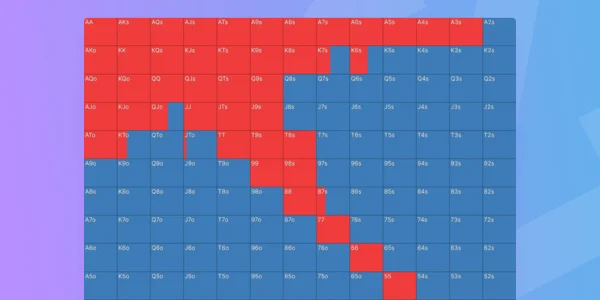
Understand how EV in poker — expected value applied to tournaments, ROI, and strategic decisions — can transform your game selection and boost your long-term profitability.
The player who wants to evolve needs to be clear on one thing: poker profit doesn’t only come from playing well, but from making decisions with positive expected value (EV+) — both in individual hands and in tournament selection.
Understanding EV in poker means understanding, mathematically and strategically, where your real growth opportunities are.
What is EV in poker?
EV (Expected Value), or expected value in poker, is a mathematical estimate that indicates how much a decision tends to profit (EV+) or lose (EV–) in the long run.
At the hand level, EV calculates whether an action (call, raise, shove) is profitable considering probabilities, opponent ranges, pot odds, and fold equity. But the concept doesn’t stop there — it also applies to tournaments, allowing you to evaluate which formats, buy-ins, and fields produce the best long-term returns.
In short:
➡ EV = the average expected profit of a decision over time.
Why EV goes beyond individual hands
Playing well pre-flop and post-flop isn’t enough if the player chooses tournaments that don’t maximize ROI. The EV of poker tournaments involves factors like:
- average field quality;
- structure (starting stack, blinds, late reg);
- speed (turbo, regular, hyper);
- rake;
- prize distribution;
- variance.
Two tournaments with the same buy-in can have completely different EV. An event with many recreational players tends to produce natural EV+; a tournament full of strong regulars, on the other hand, can drastically reduce your expected value — even if you play the hands perfectly.
How a tournament’s EV is determined by estimated ROI
ROI (Return on Investment) is the practical metric that shows how much your game returns per tournament. It serves as a bridge between real performance and theoretical EV.
The relationship between ROI and EV in poker works like this:
- High ROI = tournaments where you have more positive EV;
- Low or negative ROI = tournaments that reduce your overall expected value.
Simple example:
- Buy-in: $20;
- Estimated ROI: 40%.
Tournament EV = 20 × 0.40 = $8 per tournament.
That means, in the long run, each registration in that tournament tends to generate $8 in average profit.
That’s why professional grinders analyze not only technique, but also the type of tournament where their results are most consistent.
Why understanding EV helps build a more profitable schedule
If you play tournaments randomly, your profitability is at the mercy of variance. On the other hand, a strategic schedule based on ROI and EV lets you:
- reduce the impact of bad runs;
- maximize tournaments where you have edge;
- adjust buy-ins to your skill level;
- scale volume without compromising your bankroll;
- identify events that drain your real profit.
Knowing how to calculate EV in poker and applying it to your routine prevents you from wasting energy on unprofitable tournaments and boosts your time management as a grinder.
Conclusion: use EV to decide better where to invest your time and bankroll
Understanding EV in poker means mastering the math that sustains profitable play. Expected value isn’t just for analyzing hands — it’s for choosing tournaments with positive ROI, building an efficient routine, and creating a sustainable long-term schedule.
If you want to grow in poker, start by analyzing:
- Where is my ROI highest?
- Which tournaments have the best expected value for my profile?
- Where does my edge actually translate into profit?
Master EV and you’ll master your decisions.
Read next: