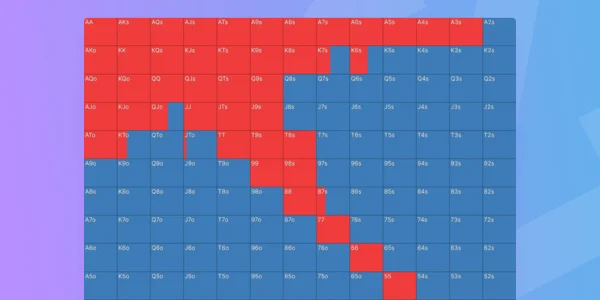
Modern poker has a language of its own, and GTO poker is one of the most discussed terms among players who take the game seriously. The theory circulates in forums, videos, and final tables, but its practical application still causes confusion. After all, what does it really mean to play GTO? And more importantly: when does this approach actually make sense?
Understanding the theory is the first step to using it intelligently. Without that foundation, any player ends up imitating behaviors without understanding why, which leads to worse decisions, not better ones. This article covers the concept, its practical application, the comparison with exploitative play, the study tools, and the differences between cash games and tournaments.
What is GTO in poker?
GTO stands for Game Theory Optimal — an optimal strategy based on game theory. In poker, a GTO strategy is one your opponent cannot exploit, no matter what they do. In simple terms: if you play GTO perfectly, nobody profits against you in the long run, even knowing your strategy.
In practice, playing GTO means balancing your value and bluff ranges so that your opponent becomes indifferent between their options. You bet with strong hands and with bluffs in the correct proportion, making it impossible for your opponent to identify a consistent pattern.
The mathematical consequence of that balance is powerful: the opponent loses their angle of attack. They don’t know whether you’re bluffing or betting for value, and any decision they make — fold, call, or raise — generates the same expected result against your strategy. That’s the central concept underpinning all modern high-level poker study.
GTO Poker vs. Exploitative Poker
This is one of the most relevant discussions in modern strategy. Exploitative play seeks to identify specific opponent mistakes and adjust your strategy to maximize profit against those mistakes, even if that means moving away from GTO equilibrium.
Imagine two simple scenarios. In the first, you’re playing against an opponent who never folds on the river. GTO strategy recommends bluffing at a specific frequency, but if you know this player calls everything, bluffing is mathematically wrong. The exploit here is simple: stop bluffing and increase the size of your value bets with strong hands. In the second scenario, you’re playing against an opponent who folds too much. GTO strategy maintains a balanced bluffing frequency, but if you know they cave under pressure, bluffing more often becomes the most profitable path.
The big difference — and the point many people miss — is that GTO vs. exploit doesn’t work as a binary choice. GTO acts as a strategic anchor. You start from equilibrium and move away from it when you have enough information to exploit an opponent with confidence. Without that foundation, exploitative play becomes guesswork, and guesswork in poker is expensive.
Why do professional players study GTO?
Professionals study GTO strategy not to play robotically within it, but to understand the fundamentals of equilibrium. When you know what GTO is, you instantly recognize when an opponent deviates, and you know how to exploit that deviation with precision.
Beyond that, at tables with unknown or highly competent opponents, GTO offers real protection. You play solidly without depending on complex reads, which is especially valuable in tournaments with large, diverse fields. In a tournament with 5,000 players, for example, you’ll never have time to map every opponent you cross. GTO works as a base strategy that protects your edge even without detailed information.
Another important point: studying GTO develops a type of strategic thinking that goes beyond poker. You start seeing each decision as part of a system of equilibrium, not as an isolated play. That structural reasoning changes how you process the table — and changes it for the better.
When to apply GTO and when to move away from it
The general rule is simple: the less you know about your opponent, the closer to GTO you should play. The more information you have about their mistakes, the more you can move away to exploit them.
In the early tables of a tournament, against unknown players, GTO protects you. You don’t know whether the guy in seat 4 is a regular or a recreational player, and trying to guess generates mistakes. Playing the balanced strategy guarantees nobody gains an edge against you while the game develops. As the hours pass, you accumulate information and start moving away from GTO toward specific exploits.
Against a player who never folds on the river or who always bluffs in a certain situation, the exploit becomes more profitable — as long as your read is correct and sustained by consistent decision-making throughout the session. The most common mistake here is starting to exploit based on a single hand. An isolated observation isn’t a read — it’s a coincidence. Exploits work when you confirm the pattern across multiple spots and stay consistent in applying them.
There’s also the opposite scenario, which few players discuss: when your opponent also knows you’re exploiting them. At that moment, returning to GTO becomes the best protection, because the adjusted opponent is already waiting for you. That dance between equilibrium and exploit is what separates high-level play from intermediate play.
Tools for studying GTO
GTO Wizard is currently the most complete and accessible tool for studying GTO strategy. It lets you analyze specific spots, compare your line with the optimal solution, and train ranges interactively. The interface has evolved considerably in recent years, and today it serves everyone from intermediate players to high-level professionals.
Other relevant options include PioSolver, considered the most technical solver on the market and widely used by professionals for deep analysis of specific spots, and SimpleGTO, focused on studying ranges and frequencies with a more accessible learning curve. Each tool has its place depending on the player’s level and the type of study desired.
These tools turn abstract concepts into concrete data, and that’s exactly why they’ve become indispensable for anyone who wants to improve with method. Studying GTO without a solver is like studying math without a calculator: possible in theory, inefficient in practice.
GTO in cash games vs tournaments
The application of GTO in poker varies by format, and that difference is fundamental to avoiding expensive mistakes. In cash games, chips have constant value, which brings theory closer to practice with more fidelity. Each decision happens in financial isolation: you risk X to win Y, and the equity calculation flows directly from the solver to the table.
In tournaments, it’s a different story. ICM (Independent Chip Model) changes the relative value of chips, especially near the bubble and the final table, which demands significant adjustments to pure GTO strategy. A call that would be correct in a cash game can be catastrophically wrong in a tournament when your position in the payouts changes the EV calculation.
In tournaments, GTO serves as a foundation, but it needs to be combined with ICM awareness and metrics like ITM and ABI to generate truly optimal decisions within the context. Without concrete data on your performance, even the best theory stays disconnected from the reality of the table. That’s why serious players don’t just study GTO — they study GTO adjusted to the format they play, with the metrics that matter for that format.
Conclusion
GTO in poker isn’t a magic formula — it’s a thinking framework that raises any player’s level. Studying game theory optimal means understanding equilibrium so you can break it intelligently when your opponent gives you an opening.
Those who master this foundation make more consistent decisions, make fewer mistakes, and build solid long-term results. Not because GTO delivers guaranteed wins, but because it eliminates guesswork and creates a rational foundation for every choice at the table.
In the end, what separates the player who grows from the player who stagnates isn’t raw talent — it’s the structure behind the decisions. GTO is part of that structure. Combine it with organization, data, and discipline, and you’ll have everything you need to play like a professional.
Organize your tournaments, track your metrics, and play like a professional. Start for free with bankroll tracking and a freeroll list included, no card required.