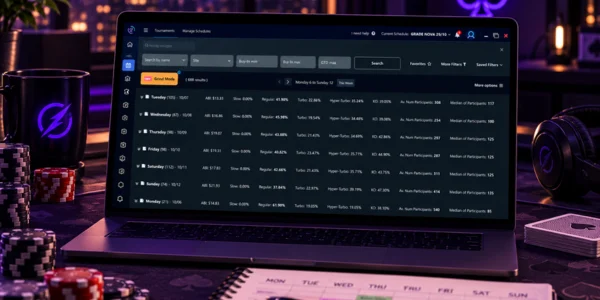
Every Sunday night, there are two kinds of grinders. The first closes the laptop after the last session and goes to bed without a thought about what’s coming. He’ll wake up Monday and see whatever’s in the lobby whenever he has time to play. The second opens his planner, looks at the week’s calendar, spreads tournaments across the days, allocates buy-ins per session and goes to bed knowing exactly what the next week is going to demand.
These two grinders can have the same technical skill. But over months, one will improve steadily and the other will bounce up and down. The difference isn’t in the game. It’s in what happens before it.
This guide explains exactly how to plan your online poker tournament week before it starts: the routine, the criteria, and the decisions that need to be made calmly on Sunday instead of improvised on Tuesday.
Why does planning your online tournament week separate consistent grinders from reactive ones?
The reactive grinder plays whatever’s running. He opens the client, sees what’s on at that moment, picks a few and plays. It looks practical, but it hides three serious problems.
First, poor game selection. Without a view of the whole week, he ends up playing subpar tournaments because they were what was available when he had time. He misses the best opportunities because he didn’t know they existed.
Second, chaotic time management. Without a plan, sessions drag on longer than they should or end before he gets to take advantage of the right window. Accumulated fatigue hurts his decisions in the hands that matter.
Third, emotional bankroll management. Without allocating ahead of time, every buy-in decision becomes a spur-of-the-moment call. And spur-of-the-moment calls are vulnerable to tilt, excitement and other emotional leaks that wreck a grind.
Weekly planning fixes all three at once. You decide calmly, looking at the full picture, and then you just execute. A clear head on Sunday makes better decisions than Tuesday under pressure.
When to plan: the Sunday night routine
The best time to plan the week is Sunday night, after your main Sunday session. A few reasons why.
Your context is fresh. You’ve just seen how the fields played, which series are underway and which tournaments caught your eye. All of that feeds better decisions for the week.
You’re already locked in. After hours of play, your focus is on poker. Using that window to plan takes advantage of mental momentum you’d lose if you left it for Monday morning.
You start the week with clarity. Monday begins with an actionable plan instead of uncertainty about what to do. That cuts down on unnecessary decisions early in the week and frees up mental energy for what matters.
The routine itself doesn’t need to be long. Thirty minutes to an hour is enough for a solid seven-day plan. If your routine stretches out for hours, that usually means your structure isn’t well defined yet.
What to review before building your week
Before deciding on any specific tournament, a few variables need to be clear.
Your current bankroll. Not what it was two weeks ago. Not what you expect it to be after the next cash. What it is now. That determines which buy-in ranges make sense for this particular week.
Time available each day. How many hours do you really have to play each day? Monday might be short, Wednesday might be free in the afternoon and evening, Sunday might be wide open. Map it out honestly.
Series on the calendar. Is a series running? Does one start this week? That changes the entire allocation, because series often deserve a bigger bankroll allocation than regular weeks.
Your current mental state. Are you coming off a good run or a downswing? How’s your tilt control? That affects whether you should take on more risk or play more conservatively this week.
Outside commitments. Meetings, family obligations, other activities. Poker doesn’t exist in a vacuum. A week packed with commitments needs a different plan than an open week.
With these five variables nailed down, you have a foundation for a realistic plan instead of an ideal plan that doesn’t survive the first Wednesday.
How to allocate hours by day of the week
Not every day of the week plays the same. Serious grinders recognize the patterns and allocate hours accordingly.
Monday. Usually a lighter day for big tournaments. A good day for medium volume, regular-speed formats, and cash games if you play them. Typical allocation: 3-5 hours.
Tuesday and Wednesday. Midweek, steady action. Series often schedule important events on these days. Typical allocation: 4-6 hours.
Thursday. The run-up to the online poker weekend. Volume starts to pick up. Typical allocation: 4-6 hours.
Friday. High activity, especially at night. A good time for expanded volume. Typical allocation: 5-7 hours.
Saturday. The first half of a strong weekend. Typical allocation: 6-8 hours.
Sunday. The big day. Sunday Million, Sunday Warm-Up, Sunday High Roller and dozens of major events. Typical allocation: 8-12 hours.
These numbers are guidelines, not rules. Adjust them to your situation, but keep the principle: an uneven distribution reflects the reality of the online poker calendar.
How to spread buy-ins across the seven days
Spreading buy-ins over the week takes a method. Here’s a simple, effective approach.
Set your weekly base buy-in budget as a percentage of your bankroll. Professional grinders often put between 2% and 4% of their total bankroll into tournaments each week. If your bankroll is $5,000, that means $100-$200 a week in buy-ins.
Spread that amount across the days based on your time allocations. Days with more hours get proportionally more volume. Sunday typically gets 30-40% of the weekly total.
Hold back a percentage for opportunities. About 10-15% of the weekly total stays in reserve for shots at bigger tournaments that pop up midweek, exclusive freerolls or other opportunities you didn’t plan for initially.
Respect your per-tournament bankroll rules. No single tournament should exceed a preset percentage of your total bankroll. Check out our article on poker bankroll management to go deeper on these rules.

Prioritizing series and the highest-EV events
Series deserve special treatment in your plan. A few criteria help.
Inflated guarantees. Tournaments with guarantees the expected field probably won’t cover can create overlay. Prioritize those.
Favorable structure. Deeper-structured tournaments favor the more technically skilled player. If you’re technically solid, these structures amplify your edge.
Fields full of recs. Series that attract casual players have softer fields. Low buy-in events in well-known series often fit that description.
Affordable satellites into bigger events. If you don’t have the bankroll to buy directly into the Main Event, cheap satellites give you a shot at big tournaments for a minimal investment.
Flag your 3-5 priority events in your weekly plan. Set up alerts well in advance. Adjust your week so you don’t miss those events because of scheduling conflicts.
How to set aside time for study and active rest
A serious grinder doesn’t play seven days a week at max volume. That isn’t dedication, it’s a straight path to burnout, which is exactly why planning your online tournament week matters.
Set aside at least one day a week for active rest. No tournaments, no heavy study. Exercise, time with family, hobbies that have nothing to do with poker. That day restores the mental capacity you need for the other six.
Set aside time to study. Ideally, 5-10 hours of structured study per week: hand analysis, solver review, reading books or watching training videos. Our article on organization as a competitive edge digs into why structured study is what keeps you improving.
Set aside time for session review. Even after long sessions, taking 15-30 minutes for a quick review locks in what you learned. Pair it with our specific method for poker session review.
Without these three protected blocks of time, you play seven days a week and don’t improve on any of them.
Midweek adjustments: when to revisit the plan
A weekly plan isn’t dogma. It needs adjusting throughout the week as reality unfolds.
Set aside 5-10 minutes on Wednesday for a check-in. How did the first few days go? Did your bankroll go up or down significantly? Do you have the mental energy for the volume planned for the second half?
Adjust without guilt. If tilt is creeping in, cut volume over the next few days. If you’re in a brutal downswing, consider taking a break. If you just hit a huge upswing, that’s no reason to impulsively bump up your buy-ins.
The goal of the plan is to give you structure, not to lock you in. Good plans survive adjustments during the week because they were built with room for the unexpected.
Tools that support weekly planning
Weekly planning gets dramatically more efficient with the right tools.
A visual multi-site calendar. A tool like Lobbyze shows every tournament from all your sites in a single interface. You plan the week in minutes instead of opening five lobbies to compare start times.
Custom filters. Filtering by buy-in, format, guarantee and start time lets you quickly find the tournaments that fit your profile for the week.
Automatic alerts. Setting alerts for your priority tournaments keeps you from missing them by forgetting at crunch time.
Built-in bankroll tracking. Seeing your updated bankroll next to your weekly plan lets you adjust in real time as results come in.
Historical performance metrics. Data from past sessions informs your current plan. Do you play turbos or regular-speed events better? On which site is your ROI highest? Those answers guide your allocation.
Common weekly planning mistakes
Five mistakes come up again and again.
An unrealistic plan. Planning 10 hours of play a day when you have 4 available leads to frustration and a sense of failure even in a good week.
A plan that’s too rigid. A plan that doesn’t allow for adjustments gets abandoned at the first obstacle. Built-in flexibility is essential.
Ignoring rest. Grinders who plan seven days of max volume with no rest built in break down within a few weeks.
Not accounting for series. Making a generic weekly plan without checking which series are running makes you miss the best opportunities on the calendar.
Not reviewing during the week. A plan made on Sunday that never gets revisited on Wednesday often loses relevance in the second half of the week.
Conclusion
Planning your online tournament week before it starts is one of the most impactful changes you can make to your grind. Not because planning is magic. Because decisions made calmly on Sunday are better than decisions improvised on Thursday.
Start simple. A 30-minute routine on Sunday night. Hours allocated per day. Buy-ins spread out. Series prioritized. Time set aside for study and rest. A tool to see it all in one interface.
Within a few weeks, the habit becomes automatic. You stop improvising and start operating with structure. And the difference shows up clearly in your results over the following months.