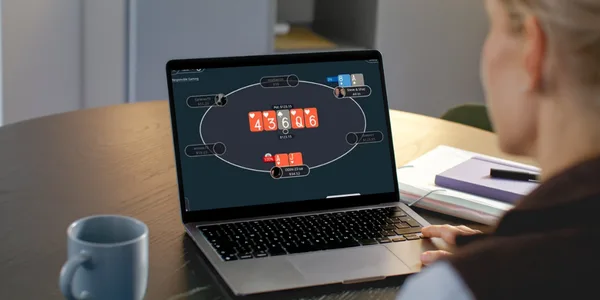
The difference between players who evolve quickly and those who stagnate rarely lies in the number of hours played — it lies in what they do afterward. The poker session review is one of the most powerful practices to accelerate technical development, and yet it’s ignored by most players. Let’s break down why that happens and how to build an analysis process that actually works.
Also check out our article: Stop Loss in Poker: What It Is, Why It Matters, and How to Calculate Yours
Why most players don’t review their sessions
The most honest answer is: emotion. After a bad session, the instinct is to close the software and forget. After a good session, the tendency is to celebrate without questioning. In both cases, learning gets left behind.
Developing emotional control in poker is the first step toward reviewing sessions with objectivity, especially after negative results.
On top of that, many players confuse a poker session review with simply rewatching hands they found interesting — which is very different from a structured analysis with a clear purpose.
What is and isn’t an effective session review
An effective review isn’t watching random hands or venting about bad beats. It’s a systematic process of identifying patterns, questioning decisions, and extracting concrete learning.
To be useful, the session review needs a defined focus: are you analyzing specific spots? Performance metrics? Deviations from your game plan? Without a central axis, the review just becomes time consumption without real return.
When to do the review: immediately after, or the next day?
This is one of the most common questions in online poker study. The answer depends on your emotional state.
Immediately after the session, you have fresh memory of the hands and context, which makes it easier to reconstruct spots. But if the session was emotionally intense, that bias will contaminate the analysis. In that case, the ideal is to quickly log the hands that caught your attention and save the deep analysis for the next day, with a clear head.
What to analyze: spots, metrics, and patterns
A complete post-session poker analysis should cover three layers:
Spots: specific hands where you felt doubt, made an unusual decision, or had an unexpected result — positive or negative. Don’t only analyze hands you lost.
Metrics: numbers like VPIP, PFR, 3-bet%, fold to 3-bet, and other indicators that reveal tendencies in your playing style throughout the session.
Patterns: behaviors that repeat. Do you always fold in a certain situation? Always lose value on rivers? These patterns are the most valuable material in any serious how to improve at poker routine.
How to tell recurring mistakes from normal variance
Not every loss is a mistake, and confusing the two is one of the biggest obstacles to reviewing sessions honestly. Variance is part of the game, and negative results in correct spots shouldn’t be treated as failures.
The criterion is simple: evaluate the process, not the result. If the decision was technically sound and the result was bad, that’s variance. If the decision was technically questionable regardless of the result, that’s an improvement point.
Tools like solvers and study assistants help you separate the two more objectively, taking ego out of the equation.
Conclusion
Doing a structured poker session review is what turns playing time into real evolution. Define a process, maintain consistency, and treat every session as a source of data — not just results. Players who study with method grow faster than those who just play more.
Lobbyze has the resources you need to optimize your strategies and planning — try it free!
Read next: