While many players evaluate their performance only by final profit or ROI rate, understanding how much you actually earn per hour is what lets you make smart decisions about grind time management, tournament selection, and career planning in online poker.
In this article, you’ll learn why tracking your hourly rate matters, how to calculate it, and how to use it to build a more profitable tournament schedule.
Why calculating hourly rate matters for poker players
While cash game players have traditionally tracked metrics like bb/100 or hourly rate, many MTT players still neglect this analysis — and as a result, they fail to understand the real efficiency of their grind.
Knowing your profit per hour allows you to:
- Compare different formats (hyper, turbo, regular, PKO, etc.)
- Evaluate whether long sessions are worth it or if shorter tournaments work better
- Plan realistic financial goals
- Organize your time between study and play
- Adjust your number of tables based on performance
- Choose more profitable times, sites, and structures
In the end, hourly rate shows whether your time is being invested smartly — and time is the most valuable resource for any grinder.
How to calculate your hourly rate in poker
The basic formula is simple:
Hourly rate = (ROI × Buy-in) ÷ average tournament duration × number of tables
But the key is doing it accurately, using your own data or tested simulations.
Practical example
A tournament player should — just like a cash game player — calculate their hourly rate, and that calculation will influence how they select the tournaments they play.
For example, a hyper turbo tournament ends much faster than a regular tournament. So the player needs to do this math based on their own ROI.
If a player has 10% ROI in a hyper turbo with a $50 buy-in that lasts 3 hours, they’d earn $1.67 per hour. If they can play 8 tournaments at the same time, that would be roughly $13.36 per hour.
- 10% ROI on a $50 tournament = $5
- $5 ÷ 3h = $1.67
- 8 × $1.67 = $13.36
Comparing formats
This simple math already lets you compare formats. For example, a regular tournament might have a higher ROI but take much longer, reducing your hourly rate. Hypers and turbos, on the other hand, offer more turnover, compensating for a lower ROI through volume.
This is where the balance comes in between:
- Poker ROI
- Tournament volume
- Table selection
- Available grind time
How ROI influences your hourly rate
ROI is the central metric for estimating profit per tournament. But on its own, it doesn’t tell the full story.
A tournament can have:
- High ROI, but poor hourly efficiency
- Low ROI, but excellent hourly rate thanks to volume
- Moderate ROI, but played across many sites and ideal time windows, maximizing results
The combination of ROI + duration + number of tables is what actually determines your profitability.
What professional grinders look for
That’s why professional grinders seek out:
- Structures that allow high volume
- Tournaments that start and end within predictable windows
- Buy-ins aligned with their bankroll
- A mix of formats that maximizes profit per hour
And of course: constant adjustments to planning as results evolve.
Conclusion
Knowing your poker hourly rate turns your grind into a more strategic, professional activity. Instead of just “playing whatever shows up,” you start using data to decide where your time generates the most return — and that completely changes your long-term results.
But calculating everything manually is exhausting. That’s where the right tool comes in:
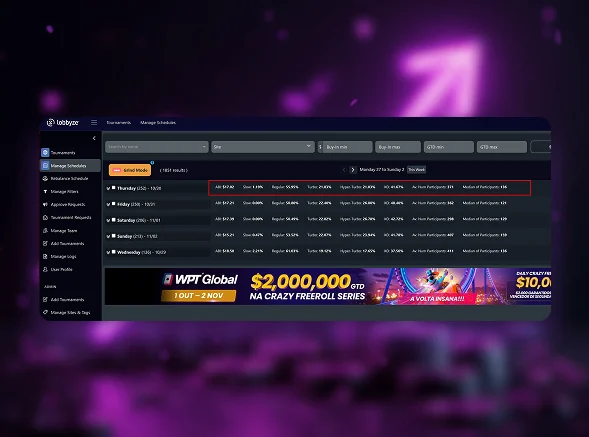
Lobbyze helps you run these simulations and understand which sites offer each type of tournament, at what time, with what volume available, and much more.
With that clarity, you can select tournaments intelligently, organize your schedule, and maximize your results.
Read next: