There’s a question every grinder asks sooner or later: do I really need to pay for these tools? Isn’t there a free version that’s good enough? Doesn’t it make sense to start free and upgrade later?
The honest answer: it depends heavily on your volume, your ambition and exactly where you’re getting stuck in your development. Free tools cover a real share of your needs. But at certain specific points, they stop working. Recognizing those points is what separates players who invest at the right time from those who spend on tools they don’t need or skimp on tools they do.
This guide breaks down exactly what free tools deliver in each category, where they hit a wall, when it’s worth paying, and how to calculate the real ROI of upgrading to pro versions.
What do free tools actually deliver?
Before getting into the limitations, it’s worth acknowledging what free tools do well. Many cover basic needs perfectly well for a certain level of play.
Free trackers. The free trials of PokerTracker 4 and HM3 let you import hand histories, calculate basic stats and use a HUD. They cover 80% of a beginner grinder’s needs.
Free solvers. Free tiers and trials of study tools (GTO Wizard’s free plan, for example) offer basic theory-study features with a limited library of pre-solved spots. Enough to start getting comfortable with GTO thinking.
Opponent analysis. SharkScope has a free version that lets you look up players’ basic history, with a daily search limit. Enough for occasional use.
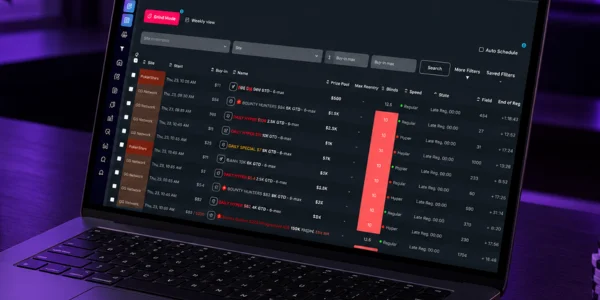
Management tools. Lobbyze has a free plan with bankroll tracking and a freeroll list. That alone delivers real value: without depositing anything, you organize your session log and get access to the freeroll category at no cost.
Homemade spreadsheets. Google Sheets or Excel can work as a basic tracking system for very low-volume grinders. Not ideal, but free.
For a recreational player or a beginner making the jump, this free toolkit often covers real needs for the first few months. The mistake is thinking these tools scale with your career. They don’t.
Where do free trackers hit a wall?
Free trackers offer the basic features, but they hit a wall at specific points.
Hand import limits. Free versions often cap how many hands you can keep in your database. For a grinder putting in volume, that cap gets hit within weeks. After that, older hands are deleted or the software stops importing new ones.
Limited HUD stats. Free versions offer basic stats (VPIP, PFR) but don’t let you set up advanced stats (fold to 3-bet by position, flop c-bet OOP, WSSD, among others). That significantly reduces your ability to analyze opponents.
Simplified reports. Post-session analysis in the free version is basic. You see total ROI, but you can’t break it down by format, time of day or site. Important patterns stay invisible.
No tech support. If something goes wrong, you’re on your own. Paid versions offer support that can save you hours of troubleshooting.
No regular updates. New sites show up, formats change. Free versions often fall behind on these updates.
For a grinder putting in real volume, these limitations turn into real roadblocks within a few months. What was enough at first stops being enough fast.
Where do free solvers hit a wall?
Free solvers let you get a taste of theory study, but they hit a wall at the points that matter.
Limited spot library. Paid GTO Wizard has hundreds of thousands of pre-solved spots. Free alternatives cover only dozens. That means most of the spots you want to study aren’t available.
No interactive training. The paid version of GTO Wizard lets you drill decisions in specific spots, with real-time feedback on your accuracy. Free versions don’t offer that kind of active learning.
Limited settings. You can’t adjust specific variables (stack sizes, custom ranges, board textures) in the free version. The analysis ends up generic.
No full tree analysis. Pro tools show the entire decision tree for each spot. Free versions only show the initial decision.
For serious study, free versions quickly fall short. They work as an entry point, not as a day-to-day work tool.
Where do opponent analysis tools hit a wall?
SharkScope’s free version offers basic lookups with clear limitations.
Daily search limit. The free version only allows a few lookups per day. For a grinder facing dozens of new opponents per session, that’s a dealbreaker.
No history details. You see overall ROI and ITM, but you can’t filter by specific format, recent time period or platform. Important patterns stay hidden.
No alerts. The paid tool lets you tag players and get alerts when they register for tournaments. The free version doesn’t offer this feature.
No data export. You can’t save opponent history for analysis over time.
For a volume grinder, these limitations quickly become roadblocks. You end up using SharkScope occasionally instead of systematically.
Where do free management tools hit a wall?
Lobbyze has a free plan that already delivers real value, but the paid plans offer features serious grinders end up needing.
Full site coverage. The free plan covers essential features on some sites. Paid plans include full coverage of the major sites, with advanced filters and targeted alerts.
Smart registration alerts. Automatic real-time notifications about tournaments with specific guarantees, series in progress, and late reg closing. Features that keep you from missing tournaments.
Advanced performance metrics. ROI by format, ABI, hourly, pattern analysis. Data that changes your future decisions.
Team and stable management. For professional operations, dedicated multi-player features.
Full bankroll integration. Automatic logging of buy-ins and cashes tied to your schedule, with no manual entry.
For a grinder playing reasonable volume, these paid features pay for themselves within a few weeks just from the tournaments you no longer miss.

How do you calculate when it makes sense to pay?
The ROI of paid tools is a math problem. You can calculate it with reasonable accuracy.
Actual cost of the upgrade. Add up the monthly cost of each paid tool you’re considering. A typical full stack runs around $80-$120 per month.
Estimated gain. Figure out how many tournaments missed due to logistics a paid tool would prevent (typically 3-5 per month) and multiply by your ABI and ROI. Also factor in how much time you save on post-session review and organization.
Decision threshold. If your estimated monthly gain is 2x your monthly cost or more, the upgrade pays for itself quickly. If the estimated gain is lower than the cost, the free version still does the job for now.
For a typical grinder playing 30-50 tournaments a month, upgrading to a paid stack usually pays for itself in 4-8 weeks. After that, it’s pure profit.
The mistake of cutting costs on the wrong tool
A lot of grinders make the mistake of skimping on the tool that would pay off most and spending on the tool that pays off least.
Prioritizing a solver over a tracker. Spending $40/month on GTO Wizard while still tracking in a spreadsheet is backward. For most grinders, a tracker pays off faster than a solver.
Buying a pro tracker but ignoring schedule management. Pro trackers deliver powerful analysis, but if you’re still missing tournaments because you don’t have proper schedule management, the money you spent on the pro tracker is wasted.
Skimping on your core tool, splurging on a complementary one. Using free Lobbyze while paying for SharkScope flips the priorities. Schedule management affects your daily operation more than occasional opponent analysis.
Rule of thumb: prioritize spending on schedule management and tracking tools, which affect your daily operation. Solvers and advanced opponent analysis come later, once you’ve nailed the fundamentals.
The recommended path for building your stack
If you’re starting out and want to build your stack in a structured way, here’s the recommended path.
Phase 1 (months 1-3). Start with free tools. Use Lobbyze’s free plan for bankroll tracking and freerolls. Use a free solver tier or trial to start getting familiar with solvers. Use free SharkScope occasionally.
Phase 2 (months 3-6). Invest in a full tracker (PT4 or HM3). It’s a one-time purchase that quickly pays for itself through session review. Set up a HUD with basic stats.
Phase 3 (months 6-12). Upgrade to a paid Lobbyze plan if you’re already playing reasonable volume. Check out our article on organization as a competitive edge in poker to see why schedule management directly affects your operation.
Phase 4 (month 12+). Consider a paid GTO Wizard plan for more advanced theory study. Add paid SharkScope if you start playing against the same regs repeatedly.
Phase 5 (professional grinder). A complete stack with every top-tier tool. Ongoing optimization.
This path protects your bankroll in the early months, when your ROI is still low, and lets you scale your spending as your volume and edge grow.
How to get the most out of free versions
Before deciding to upgrade, squeeze every bit of value out of the free versions.
Set them up properly. A lot of grinders run free tools at less than full potential because they never configured them correctly. Spend a few hours on setup up front and you’ll get much more out of them.
Focus on the essential stats. A free HUD with well-configured basic stats is often more useful than a complex, poorly configured one. Prioritize quality over quantity.
Combine free tools. No single free tool covers everything, but smart combinations cover a lot. Free Lobbyze + a basic tracker + a spreadsheet for extra metrics is enough for a beginner grinder.
Review your data regularly. Even with the limits of free versions, check your numbers on a set schedule. Our article on key metrics like ITM and ABI goes deeper into which data to pull.
Common mistakes when deciding between free and paid tools
Five mistakes come up often.
Buying everything paid too early. Spending $500 on tools in your first month before mastering the basics is common and inefficient. Grow your stack as your needs grow.
Staying on free tools too long. Some grinders stick with free tools even after they’ve become an obvious roadblock. Recognize when it’s time to upgrade.
Choosing by brand instead of fit. An expensive tool isn’t necessarily better for you. Fit with your operation matters more than popularity.
Not calculating ROI honestly. “It’ll be worth it” without specific math often leads to the wrong investment.
Ignoring the free plans of paid tools. Before ruling out a paid tool, try its free plan. Many offer trial or free versions with real features.
Conclusion
Free vs. paid poker tools isn’t a binary debate. It’s a progression: you use free versions early on, identify the specific roadblocks holding back your development, and make targeted upgrades when the ROI justifies it.
For most serious grinders in 2026, a full paid stack pays for itself within weeks and then becomes a lasting competitive advantage. For beginners and recreational players, free versions cover real needs for months.
The key is honesty: don’t stay on a free tool when it’s holding back your growth. Don’t invest in an expensive paid tool when you haven’t mastered the basics yet. Building your stack is a strategic decision, not an emotional one.
Get the most out of Lobbyze with tools built for players like you!