There’s a common argument among newer grinders that needs to be challenged: “I already use the PokerStars lobby, it shows every tournament, so why do I need Lobbyze?” The question sounds reasonable. After all, every site has its own lobby that lists all the tournaments it offers. Why add another tool?
The answer reveals something that single-site players usually don’t even consider: you’re not seeing everything. You’re only seeing what that site offers. And what it offers can be a small fraction of what’s running across the global market at any given moment.
This guide explains exactly what you miss when you play on just one site, how Lobbyze changes that picture, and why that shift in perspective is often the difference between a grinder who stalls and a grinder who scales.
What the site’s native lobby shows
Every online poker site has its own lobby built into the client. And it does what you’d expect: it lists the tournaments that site runs.
PokerStars. The lobby shows the Sunday Million, SCOOP, WCOOP, regular daily tournaments, Spin & Gos, and cash games. A robust interface with filters for buy-in, format, and start time. A huge number of options, all inside the PokerStars ecosystem.
GGPoker. Similar, but with its own ecosystem: GGSeries, Bounty Hunters, WSOP Online, GGMasters. Formats like Flip & Go and Mystery Bounty. High volume, but all contained within GGPoker.
WPN/ACR. The lobby shows the Venom series, the Sunday Special, and WPN-specific daily tournaments. Solid coverage of what that network offers.
partypoker. MILLIONS Online, Powerfest, regular tournaments. Focused on the partypoker calendar.
888poker, iPoker, Winamax, WPT Global, and other sites. Each with its own lobby showing its own schedule.
That works fine if you only want to play on that particular site. You open the lobby, see what the site offers, and choose from what’s in front of you. It’s a complete system for anyone operating inside a single ecosystem.
The problem is that serious grinders in 2026 rarely operate in a single ecosystem.
What you can’t see with a single lobby
When you only use one site’s lobby, you lose sight of several categories of opportunities running in parallel across the market.
Special series on other sites. While SCOOP is running on PokerStars, GGSeries might be running on GGPoker at the same time. The Venom might be underway on WPN. A Winamax series or partypoker’s Powerfest might be going on too. Each with seven-figure guarantees, affordable satellites, and unique opportunities. If you only play PokerStars, all those other series are invisible to you.
Overlay tournaments on smaller sites. Smaller sites often have guarantees bigger than the actual demand, creating significant overlays. If you only play PokerStars or only GGPoker, you probably don’t even know those overlays exist. Grinders who play multiple sites hunt down these spots and extract significant EV.
Unique formats on each site. GGPoker has Bounty Hunters and Flip & Go. PokerStars has Spin & Go. WPN has the Beast progressive leaderboard. Every site has innovated with its own formats. If you stick to one site, your options are limited to what it offers.
Series launched on smaller sites. New series launch all the time, especially on growing sites. WPT Global has launched several major series in recent years. If you’re not actively following those sites, you find out weeks or months later, after the best opportunities have already passed.
Structural differences between sites. The same buy-in on different sites comes with different payout structures, different fields, and different difficulty. A $50 tournament on PokerStars vs. GGPoker vs. WPN is a completely different experience. Without a side-by-side view, you keep playing the same kind of field without trying the alternatives.
How a multi-site tool changes the picture
A tool like Lobbyze pulls the schedules of multiple sites into a single interface. The shift in perspective is dramatic.
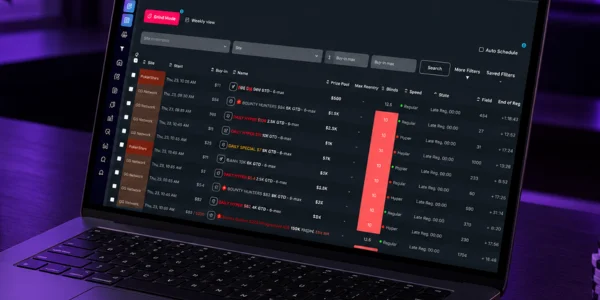
A complete view of your options. You open one interface and see every tournament available right now on PokerStars, GGPoker, 888poker, partypoker, WPN/ACR, Winamax, WPT Global, Chico Network, iPoker, Bodog, CoinPoker, and SupremaPoker. Filters for buy-in, format, guarantee, and start time show you exactly the options that fit your profile.
Finding hidden spots. Overlays on smaller sites, special series you didn’t know existed, formats you’ve never tried. It all shows up in your view.
Instant cross-site comparison. In the same time slot, you see a $30 tournament on PokerStars next to a $25 tournament on GGPoker next to a $40 tournament on WPN. You compare structures, guarantees, and field sizes instantly.
Session optimization. You plan your session around the full universe of options instead of limiting yourself to what one site offers. The result: better game selection, more volume in the right spots, and less time wasted in suboptimal tournaments.
Less risk of missing unique opportunities. Exclusive freerolls, special series, tournaments with unusual structures, new-site promotions. All of these become visible when you have multi-site coverage.
Real-world scenarios where the difference shows
A few concrete scenarios show how this shift in perspective affects real-world play.
Scenario 1: Sunday night. Grinder A only plays PokerStars. He sees the Sunday Million ($109 buy-in), the Sunday Special, the Warm-Up, and a few smaller tournaments. He registers for three or four. Grinder B uses Lobbyze and sees the Sunday Million on PokerStars, the Sunday majors on GGPoker, the Sunday Special on WPN, the big Sunday guarantees on partypoker, and in-house series on other sites. He compares buy-ins, guarantees, and fields. He builds a diversified Sunday lineup that maximizes the session’s total EV.
Scenario 2: Wednesday afternoon. Grinder A opens the PokerStars lobby. He sees a few $10–$50 tournaments. Nothing special. He thinks about skipping the session. Grinder B uses Lobbyze and finds a Winamax series event whose guarantee is too big for the demand, creating an overlay, plus a $20 tournament on a softer, less crowded site. He registers and plays those spots with much better EV.
Scenario 3: A new series kicks off. Grinder A only plays PokerStars and knows SCOOP starts in two weeks. Grinder B uses Lobbyze and sees that SCOOP starts in two weeks, GGSeries in three, the Venom in one, and an 888 series in four. He plans his bankroll allocation across multiple series at once. For more on structuring that allocation, see our article on planning your grind with weekly and monthly goals.
Scenario 4: Saturday with no plan. Grinder A opens PokerStars, sees what’s running, and jumps into whatever pops up. A reactive session with no game selection. Grinder B uses Lobbyze on Friday night to review all of Saturday across every site. He picks out the day’s 5 best spots from all the options. He registers in advance with alerts set up. A planned, optimized session.
Over months, the accumulated difference in EV is huge.

Why solo grinders usually stick to one site
If multi-site play is so much better, why do so many grinders stay on a single site? There are a few legitimate reasons.
Not knowing the alternatives. A lot of newer grinders simply don’t know there are significant opportunities on other sites. They start on PokerStars or GGPoker, learn how to play that particular site, and never look beyond it.
Convenience and familiarity. A familiar lobby, an account already set up, deposit methods in place, an established rakeback deal. Switching sites comes with setup and learning costs.
Not enough volume to justify it. A grinder who plays only a few tournaments a week may not feel the need for multi-site optimization. Low volume makes the difference less obvious.
Confusion about tools. Some grinders assume a tool like Lobbyze requires advanced technical knowledge. It doesn’t. The interface is intuitive and the learning curve is short.
None of these reasons is good enough for a serious grinder to stay on a single site. They’re all hurdles you can clear, and your game improves dramatically once you do.
What changes when you go multi-site
Moving to multi-site schedule management changes your operation in several ways.
Optimized volume. You stop forcing sessions at times when your site’s schedule is thin. You choose times and tournaments based on the whole ecosystem.
Better ROI. With access to more options, you pick better spots. The same volume in better tournaments produces a better ROI.
Spreading your risk. If one site goes through a rough patch (a major update that breaks the software, a policy change, shrinking fields), you’re not stuck with it. Spreading your volume reduces your dependence on any single site.
Discovering new formats. You try out formats unique to different sites. Some of them might become your specialty. Our article on types of poker covers how diversifying formats widens your edge.
Site-by-site rakeback. You concentrate volume on the sites where your rakeback tier is highest, maximizing your overall return. Check out the article on poker rakeback to understand that side of things.
Fewer losses from logistics. Automatic alerts, coverage of every site, custom filters. You stop missing tournaments because you weren’t paying attention or weren’t checking the right site at the right time.
Common objections to playing multiple sites
A few objections come up when grinders push back on playing multiple sites.
“I don’t have time to manage multiple accounts.” Counterpoint: managing multiple sites through Lobbyze takes less time than manually managing a single site with no tool. You save time; you don’t spend it.
“I’d rather master one site before expanding.” Counterpoint: mastering a site doesn’t mean restricting yourself to it. You can keep PokerStars as your main site while adding 2–3 others for specific spots.
“My bankroll isn’t big enough to diversify.” Counterpoint: playing multiple sites doesn’t mean splitting your bankroll evenly. You keep most of it on your main site and play select spots on the others.
“I already make enough on one site.” Counterpoint: if you make X on one site, you probably make 1.3X to 1.5X with an optimized multi-site setup. The question is: why leave 30–50% of your EV on the table for convenience?
These objections usually reflect inertia more than rational analysis. Grinders who get past that inertia typically report a substantial boost in performance.
How to get started playing multiple sites
If you’ve made it this far and you’re thinking about expanding to multiple sites, a few steps will help.
Step 1. Sign up for Lobbyze’s free plan. Start exploring the interface and seeing what’s out there beyond your current site.
Step 2. Open an account on one or two additional sites with a strong player base in your region. GGPoker and WPN are natural candidates if you already play PokerStars.
Step 3. Deposit a small amount on each new site (somewhere in the $50–$100 range) to start testing.
Step 4. For the first few months, play mostly on your main site (75–85% of your volume) and try the new ones for specific spots (overlays, special series, unique formats).
Step 5. After 3–6 months, review your ROI on each site and adjust how you split your volume. You may find that a new site delivers a significantly higher ROI than your main one.
Step 6. Consider Lobbyze’s paid plan to get the most out of alerts, built-in bankroll tracking, and advanced metrics. The investment pays for itself quickly with the extra volume.
Conclusion
Lobbyze vs. the native lobby isn’t a contest between similar tools. It’s a choice between a limited operation and an optimized one. The native lobby shows what the site offers. Lobbyze shows what the market offers.
A grinder who plays on a single site often doesn’t even know what they’re missing. Overlays on smaller sites, special series running in parallel, unique formats, one-off opportunities. That whole layer of value stays invisible when you’re working with a narrow view.
For serious grinders in 2026, multi-site play through a schedule management tool is the standard. It’s not a luxury, and it’s not optional once you’re past recreational volume. It’s the difference between working with half the tools available and working with the full arsenal the market has to offer.