Knowing the poker hand rankings is the first step for anyone who wants to play with confidence. Before thinking about strategy, bluffing, pot odds, or any advanced concept, you need to master one thing: which hand beats which. Without that, everything else collapses.
The good news is that this hierarchy is simple and never changes. There are ten possible combinations, organized from the strongest (and rarest) to the weakest (and most common). In this guide, you’ll get to know each one with clear examples, understand why this order exists, and learn to apply that knowledge in practice during a real hand.
Why is knowing the poker hand rankings essential?
Poker hand rankings aren’t just rote memorization for beginners. They’re the foundation of every decision you make at the table.
Think of it this way: when you decide to call a bet, bluff, fold, or go all-in, all of those choices depend on a quick assessment of how strong your hand is relative to what your opponent might have. Without mastering the hierarchy, you can’t make that assessment. And without that assessment, you’re just guessing.
Another important point: the poker hand order is the same across practically every variant of the game. Texas Hold’em, Omaha, Seven Card Stud — they all use the same hand rankings. Learn it once and it serves you for the rest of your career.
The logic behind the hierarchy is also mathematical. The harder a combination is to form, the higher it sits on the scale. A Royal Flush is extremely rare, so it beats everything. A high card is trivial, so it loses to any other combination. Players who understand this logic memorize the rankings much faster than those who try to memorize them mechanically.
Royal Flush: the strongest hand in poker
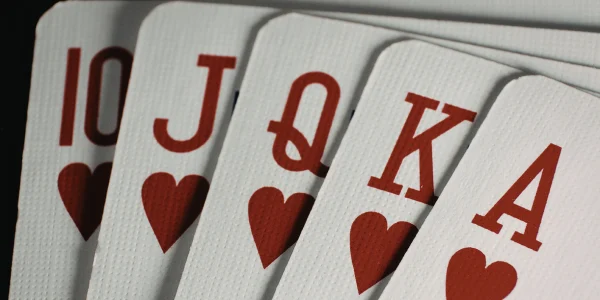
The Royal Flush is the strongest hand in poker. It’s made up of ten, jack, queen, king, and ace, all of the same suit.
Example: 10♠ J♠ Q♠ K♠ A♠
The probability of receiving a Royal Flush in a Texas Hold’em hand is approximately 1 in 30,939 — extremely rare. Many players go entire careers without ever making one. When it happens, you’re practically certain to win the hand, because no other combination beats it.
There’s no difference in value between Royal Flushes of different suits. All four suits carry the same weight.
Straight Flush: a sequence of the same suit
The Straight Flush is a sequence of five consecutive cards, all of the same suit. It sits just below the Royal Flush (which is technically the highest possible Straight Flush).
Example: 5♥ 6♥ 7♥ 8♥ 9♥
In a tie between two Straight Flushes, the one with the highest card wins. A 6-to-10 Straight Flush beats a 2-to-6 Straight Flush.
The probability of making a Straight Flush in Texas Hold’em is about 1 in 3,589 — still extremely rare. When this hand appears, it practically guarantees victory, losing only to a Royal Flush.
Four of a Kind: four equal cards
Four of a Kind, also known as quads, is made up of four cards of the same rank plus any other card (the so-called kicker).
Example: 9♠ 9♥ 9♦ 9♣ K♠
In a tie between two quads, the higher-ranked one wins. Four Kings beat four Queens. If both players have the same quads (which only happens in some specific formats), the kicker breaks the tie.
The probability of making quads in Texas Hold’em is approximately 1 in 594. It’s a considerably rare hand, and when it appears, it usually means a big pot.
Full House: three of a kind plus a pair
The Full House is the combination of three of a kind with a pair. In other words, three cards of one rank plus two cards of another rank.
Example: J♠ J♥ J♦ 4♠ 4♥ (three Jacks and two Fours)
Traditional naming describes the three of a kind first and the pair second. In the example above, the correct reading is “Jacks full of Fours.”
The tiebreaker between two Full Houses goes first to the strength of the three of a kind. Kings full of Twos beats Queens full of Aces. If the three-of-a-kind portions are equal (a rare scenario), the pair decides the winner.
The probability of making a Full House is about 1 in 37, making it one of the most profitable hands in the game: strong enough to win most pots and common enough to appear regularly.
Flush: five cards of the same suit
The Flush is made up of five cards of the same suit, with no need for them to be consecutive.
Example: 2♠ 6♠ 9♠ J♠ K♠
The tiebreaker between two Flushes goes to the highest card. If the highest card ties, the second highest is compared, and so on. The suit itself has no influence on the tiebreaker, contrary to what many people believe.
The probability of making a Flush in Texas Hold’em is approximately 1 in 32, making it one of the most common hands among the strong combinations. That’s why the Flush is one of the hands that most often generates big pots — and coolers, those situations where two Flushes collide.
Straight: five cards in order
Five cards in consecutive order, regardless of suit, form the Straight.
Example: 4♠ 5♥ 6♦ 7♣ 8♠
An important point: the ace can work both as a high card (forming the 10-J-Q-K-A sequence, called “Broadway”) and as a low card (forming the A-2-3-4-5 sequence, called the “wheel”). It’s the only card with that dual role in the poker hand order.
The tiebreaker between two Straights goes to the highest card in the sequence. An 8-to-Q Straight beats a 5-to-9 Straight.
The probability of making a Straight is about 1 in 21, making it one of the most common mid-strength hands. It beats three of a kind, two pair, and everything below, but loses to the Flush, Full House, Four of a Kind, Straight Flush, and Royal Flush.
Three of a Kind: three equal cards
Three of a Kind is made up of three cards of the same rank plus two cards different from each other.
Example: 8♠ 8♥ 8♦ K♠ 2♣
There’s an important distinction within three of a kind. When you form it using both of your cards (a pair in your hand plus one on the board), it’s called a “set.” When you form it using only one card from your hand (plus two on the board), it’s called “trips.” Sets are more valuable because they’re much harder for opponents to read.
The rank of the three of a kind itself breaks ties between two of them. If the three-of-a-kind portions are equal (possible in some variants), the tiebreaker goes to the kickers.
The probability of making Three of a Kind in Texas Hold’em is approximately 1 in 20.
Two Pair
Two Pair is the combination of two pairs of different ranks plus a fifth card (kicker).
Example: Q♠ Q♥ 7♦ 7♣ A♠ (a pair of Queens and a pair of Sevens, with an Ace kicker)
The naming leads with the higher pair: “Two Pair, Queens and Sevens.”
The tiebreaker between two players holding Two Pair works on three levels. First, the higher pair is compared. If that ties, the second pair is compared. If both pairs are equal, the tiebreaker goes to the kicker.
The probability of making Two Pair is about 1 in 4, making it one of the most frequent mid-strength hands. It’s strong enough to win most small pots, but vulnerable to bigger hands when the betting gets heavy.
One Pair
One Pair is simply two cards of the same rank plus three cards different from each other.
Example: A♠ A♥ K♠ 7♦ 2♣ (a pair of Aces with King, Seven and Two kickers)
The tiebreaker between two equal pairs goes to the highest kicker. If the first kicker ties, the second is compared, and so on.
The probability of receiving a pair is approximately 42% in a five-card hand, making it the second most common combination in the game. Because it’s so frequent, pairs tend to be vulnerable hands in contested pots, especially in the later stages of hands.
High Card
When none of the previous combinations is formed, the hand is worth only its highest card. It’s the weakest possible hand in poker.
Example: A♠ K♥ 9♦ 7♣ 3♠ (Ace high)
The tiebreaker between two players with high cards works from the highest card down. If both have an Ace as their high card, the second highest card is compared, and so on until a difference is found.
The probability of having only a high card after receiving five cards is about 50%. In other words, half of all hands form no combination at all. That’s why winning with high card in contested pots is rare — it usually happens when everyone folds and the hand is decided at showdown only among those who made it to the end.
How to apply the hand hierarchy in practice
Knowing the poker hand rankings is just the starting point. What really makes a difference is knowing how to apply that knowledge in real time, during a hand.
The first practical application is evaluating your hand’s relative strength on each street. Three of a kind on the flop is strong, but it can become vulnerable on the turn if cards appear that complete flushes or straights. Knowing how to identify when your hand is “improving” or “deteriorating” relative to the board is a central skill of the game.
The second application is estimating your opponent’s range. Each possible combination has an associated probability, and experienced players think not only about their own hand, but about which hands the opponent could have given the action so far. This skill develops with consistent practice, and it becomes much more solid when you combine knowledge of the hierarchy with studying odds and pot odds.
The third application is decision-making under pressure. Instantly knowing that your hand is the second-best possible, or that only one combination on the board beats you, completely changes how you play that hand. That’s a level of reading that separates recreational players from regulars.
Finally, mastering the poker hand rankings is what allows you to advance to more sophisticated concepts like table positioning, bet sizing variation, and postflop strategies. Without the solid foundation of the hierarchy, those concepts remain too abstract to apply consistently.
Conclusion
The poker hand rankings are the basic vocabulary of the game. Without them, no strategy makes sense. With them, you open the door to everything that comes next: reading opponents, managing pots, calculated bluffs, and mathematically grounded decisions.
Start with the essentials: memorize the order of the ten combinations, from the Royal Flush down to High Card. Practice identifying your hands quickly in real sessions or training tools. And as you advance, connect this knowledge to the other pillars of the game, like first steps in online poker and organizing your study routine.
Players who master the foundation play better at any level. Players who ignore it stay trapped in intuitive decisions that cost dearly in the long run.
With Lobbyze you get exclusive tournament information, personalized alerts, results management, and exclusive schedule auditing for poker teams.