The question “is poker luck or skill” is one of the most debated in the world of card games. The issue creates controversy not only among beginners, but also in academic, legal, and regulatory circles.
The answer, while complex, has deep implications for how we approach and study this fascinating game that combines mathematical, psychological, and strategic elements.
Why this question is so common among beginners
Many people question whether poker is a game of chance because of the random nature of the cards dealt. In a single hand, a beginner player can defeat the best professional in the world simply by being dealt better cards. This immediate reality creates the impression that the outcome depends exclusively on luck.
Short sessions amplify that misperception. A player can make technically perfect decisions and still lose money due to unfavorable card distribution. That frustrating experience leads many to incorrectly conclude that poker is purely chance-based.
How skill manifests in the long term
The true nature of poker long term reveals that skill is the determining factor for consistent success. Professional players don’t win by chance — they master concepts like pot odds, positional play, bankroll management, and opponent reading.
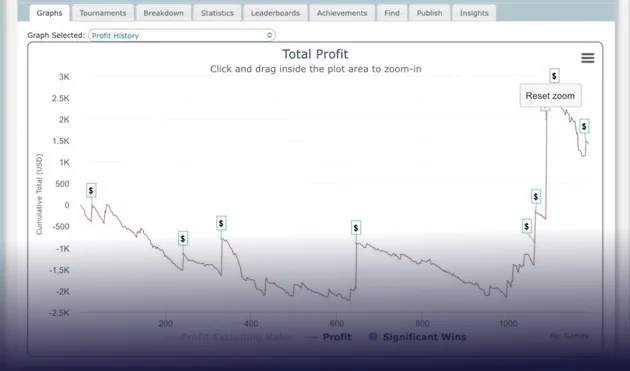
Probability in poker works as a balancing force: in the short term, anything can happen, but over thousands of hands, results tend to reflect players’ true skill. Experienced professionals maintain positive winrates for years on end — something statistically impossible if the game were purely luck.
Academic studies confirm that skilled players consistently produce superior results when analyzed across large samples. The ability to make correct decisions repeatedly, even with incomplete information, separates winners from losers.
What variance is and why it confuses results
Variance in poker represents the difference between expected and actual short-term results. Even when making mathematically correct decisions, a player can experience losing streaks due to the natural distribution of probabilities.
This natural fluctuation confuses many players about the game’s true nature. Downswings (streaks of negative results) can last weeks or months, even for highly competent players. Upswings (positive streaks) can also temporarily mask technical deficiencies.
Why consistent players win over time
The long-term result in poker consistently favors players who apply fundamentally sound strategies. The law of large numbers ensures that, with enough time, skill overcomes luck as the determining factor.
Winning players develop their edge through continuous study, hand analysis, emotional control, and constant adaptation. They understand that any individual decision may not produce the desired result, but that consistent decision quality will inevitably produce profit.
Conclusion
Poker is fundamentally a game of skill disguised as luck in the short term. While variance creates significant fluctuations in individual sessions, the long term unequivocally reveals that knowledge, strategy, and discipline determine success.
Understanding this distinction is essential for any serious player seeking consistent evolution in poker. Organize your tournaments, track your results, and play with clarity. Try Lobbyze free for 7 days.
Read next: