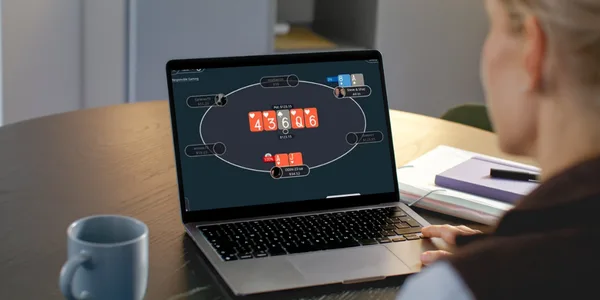
When it comes to online poker, one name has been the absolute reference for over two decades: PokerStars. The biggest and most traditional platform in the world, it’s the starting point for millions of players — and it remains a destination for professional grinders in 2026.
In this complete PokerStars guide, you’ll understand how the platform works from the inside, what its main tournaments are, how to create and verify your account and, above all, how to get the most out of it from day one. Because knowing the software is one thing; using the platform with method is quite another.
What is PokerStars?
PokerStars is the biggest online poker room on the planet. Live since 2001, the platform built its reputation on three pillars: reliability, security, and game integrity. Over more than twenty years, it has survived regulatory changes, industry crises, and the rise of dozens of competitors — and it remains on top.
Part of that longevity is explained by volume. More players mean fuller tables, tournaments with bigger guarantees, and availability at practically any hour of the day. For anyone playing volume, that matters as much as the interface.
In Brazil, the platform offers Portuguese-language support and payment methods adapted to the local reality — one of the reasons the country became one of the room’s largest communities. If you want to understand that context better, it’s worth reading about the state of poker in Brazil in 2026.
How to create an account, verify it and withdraw on PokerStars
Creating an account is simple: just provide basic information, choose a nickname, and complete identity verification. That last step tends to raise questions, but it’s industry standard — the platform requests a photo ID and proof of address to unlock financial transactions.
A practical tip: complete verification before you need to withdraw. Many players leave it for later and end up with a locked withdrawal exactly when they want to move their bankroll.
The PokerStars app, available for iOS and Android, lets you play from anywhere with stability close to the desktop client. Even so, for anyone playing multiple tables, desktop remains the natural choice — the bigger screen makes a real difference in decision quality.
As for withdrawing from PokerStars, the platform offers different options, including digital wallets and bank transfers, always after account verification. Timeframes vary by method, and it’s worth checking the up-to-date conditions directly on the site.
The platform’s main tournaments: Sunday Million, SCOOP and WCOOP
PokerStars tournaments are the heart of the platform. Before diving into the best-known names, it’s worth understanding that the room covers practically every existing format — from the traditional freezeout to rebuys and knockouts, through regular, turbo and hyper structures.
The most famous tournament is the Sunday Million, the most traditional Sunday major in online poker. With a guaranteed prize pool in the million-dollar range and a relatively accessible buy-in, it became a landmark of the global calendar and one of the most contested tournaments in existence.
Beyond it, two series stand out:
→ SCOOP (Spring Championship of Online Poker), usually held between April and May
→ WCOOP (World Championship of Online Poker), traditionally in September
Both gather dozens of events, millionaire prize pools, and satellites that allow qualification from low stakes. In practice, they work as showcases for rising talent — several players have built careers from a deep run in an online series.
On the other hand, concentrated series demand planning. Dozens of events in a few weeks mean constant schedule overlaps, and that’s where building your schedule in minutes with Lobbyze stops being a convenience and becomes a necessity.
How freerolls work on PokerStars
Freerolls are free tournaments that award real cash prizes. For anyone learning how to play on PokerStars, they’re an excellent entry point: you gain competitive experience without risking your own bankroll.
The platform offers daily freerolls, plus exclusive events for new players and for those participating in specific promotions. It’s the safest way to build a bankroll from zero, without depositing.
One strategic warning, though: freerolls have gigantic fields and very loose players. Precisely for that reason, they work better as training for endurance and table reading than as a primary source of bankroll. Treat them as a laboratory — not as a career plan.
Welcome bonus and the Stars Rewards program
New players typically receive a welcome bonus on their first deposit, released progressively according to play volume. In other words, it’s not immediate money: it’s a reward for activity, unlocked in installments.
The Stars Rewards program, in turn, rewards continuous activity on the platform. The more you play, the more rewards you accumulate, usually through chests that release varied prizes — from account cash to tournament tickets.
Still, some direct advice: never choose where to play based on the bonus alone. Tournament structure, schedules compatible with your routine, and field quality weigh far more in the long run. And of course, always check the up-to-date terms directly on the platform before depositing.
How to organize your PokerStars schedule with Lobbyze
With such an extensive schedule, selecting the best tournaments can be challenging. There are hundreds of events per day, spread across different buy-in ranges, formats and times — and navigating the lobby manually consumes time that should be spent playing.
Lobbyze helps centralize your schedule in a single calendar, with filters by buy-in, time, and guarantee. That way, you build your PokerStars schedule in advance, prioritize the tournaments that make sense for your profile, and play with full focus.
In practice, the difference is significant. Players who plan their schedule avoid missing tournaments for lack of planning, manage to set weekly and monthly goals, and stop registering for tournaments at random. It’s no coincidence that organization is one of the biggest differentiators between recreational and regular players.
On top of that, smart alerts notify you about tournament starts and late registration, something especially useful on busy series days. And if you still manage everything manually, it’s worth comparing software and spreadsheets — the difference in scale is evident.
The most common mistakes of PokerStars beginners
Some mistakes repeat so often they’ve become a pattern. It’s worth knowing them before making them:
→ Playing above your bankroll. The most classic of all. Without bankroll management, any bad stretch becomes a structural problem.
→ Ignoring your own ABI. Moving up in stakes on impulse, rather than consistency, is a recipe for frustration. Understanding what ABI is and how it defines your level helps keep your feet on the ground.
→ Skipping learning stages. Before facing big fields, master the basics: Texas Hold’em rules, hand strength and table position.
→ Not taking advantage of freerolls. Failing to use the cheapest training tool available is pure waste.
→ Confusing variance with incompetence. Long downswings happen even to good players, and understanding the impact of variance prevents emotional decisions.
→ Playing on tilt. Bad stretches take a mental toll. Knowing how to identify tilt and regain control is worth more than any technical adjustment.
→ Not tracking metrics. Without ITM, ABI and other indicators, volume becomes repetition — not learning. A structured session review closes that loop.
Conclusion
PokerStars remains one of the most complete and consolidated platforms in online poker. Legendary tournaments, accessible freerolls, and a mature ecosystem provide the structure a player needs to evolve consistently.
But the platform is only half the equation. The other half is organization. Respect your bankroll, take advantage of the available resources, and use the right tools to turn volume into real progress — because tracking dozens of simultaneous tournaments manually simply doesn’t scale.